In the summer of 2018, the gaming world was shaken by an exposé on sexism at Riot Games, the company behind League of Legends. The story quickly spread beyond the gaming industry and entered mainstream media, including the Dutch national news outlet NOS.
As one of the few women leading a game development studio in the Netherlands at the time, NOS reached out to me for an interview about my own experiences in the gaming industry. We spoke about gender bias, everyday challenges, and the subtle ways in which women in tech often have to adapt to be taken seriously.
In the article, I mentioned that I was often taken more seriously when dressed casually (in a hoodie and sneakers) than when I appeared “too feminine.” It was a small but telling example of the quiet, persistent double standards that still shape perceptions in tech and gaming. I also emphasized that, although the situation in the Netherlands wasn’t as severe as the toxic workplace stories coming from Riot Games, gender inequality was still very real.
It was an honor to be featured in a national news article on such an important topic. But what surprised me most came later. The conversation about women in gaming and IT spread quickly online, and somewhere deep in a Reddit thread about sexism in the industry, I stumbled upon a comment by a (presumably Dutch) user who quoted my interview. It came about it completely by coincidence, which made the moment feel all the more surreal.
They described my remarks as “nuanced” and “not overly dramatic,” appreciating that I had acknowledged both the problems and the progress. My interview was cited as a credible source within their discussion. My words had found their way into an international conversation on gender in gaming, not as outrage, but as context.
That moment stayed with me. Not because of visibility, but because it reminded me that even simple honesty can travel far. Sometimes, the most meaningful contribution you can make is to speak truthfully, without exaggeration, and let others find their reflection in that balance.
Archive Info
Original Language: Dutch Title: Seksisme bij maker League of Legends, ‘zo is de game-industrie’
Publication Date: 09 August 2018
Publisher: NOS
Direct Link: Interview on NOS
About This Archive
Welcome to my Media Archive. In this curated collection, I explore the media appearances and interviews that have marked my journey through technology and beyond. This archive is not just a record of professional milestones; it is a personal journey through moments that have defined and shaped my public persona.
Article & Translation
Original Article (Dutch)
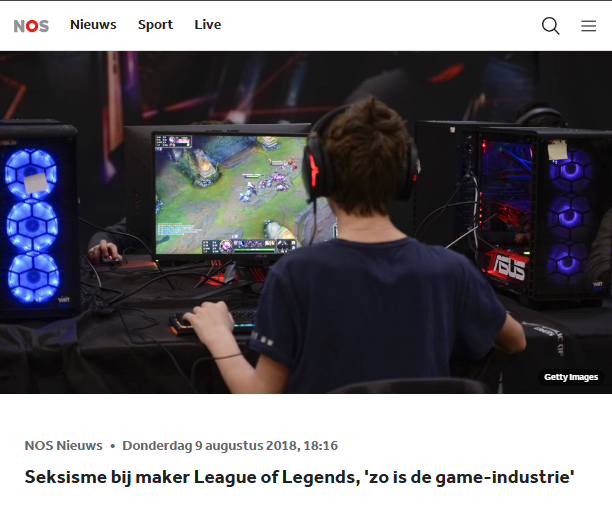
Seksisme bij maker League of Legends, ‘zo is de game-industrie’
Foto’s van geslachtsdelen, lijstjes met ‘geschikte vrouwen’ en promoties die aan vrouwen voorbijgaan. Bij de grote Amerikaanse gamemaker Riot Games heerst een seksistische cultuur, schrijft gamewebsite Kotaku.
Riot Games is vooral bekend van het online-spel League of Legends (LoL), dat maandelijks wordt gespeeld door tientallen miljoenen mensen. Een verslaggever interviewde 28 (ex-)medewerkers. De meesten gaven aan dat vrouwen het niet makkelijk hebben bij het bedrijf, waar zo’n 2500 mensen werken.
Een vrouw vertelt hoe een idee van haar werd afgewezen in een vergadering. Als experiment pitchte een mannelijke collega hetzelfde idee een paar dagen later aan dezelfde groep mensen. “En iedereen zei: ‘o mijn god, dit is fantastisch’. Ze hebben gewoon geen respect voor vrouwen.”
Een andere medewerkster vertelt dat ze een e-mailconversatie onder ogen kreeg waarin beschreven was hoe het zou zijn om haar “te penetreren”. Een van de collega’s schreef dat het een goed idee zou zijn om met haar naar bed te gaan om vervolgens niks meer te laten horen.
“De bro culture is er zó aanwezig”, zegt een van de geïnterviewden die ontslag heeft genomen vanwege seksisme. “Het lijkt wel alsof je bij een hele grote studentenvereniging werkt.” Bro culture refereert naar mannen die elkaar aanspreken met bro (broeder).
Overigens is Riot Games zeker niet het eerste game-bedrijf dat onder vuur komt te liggen vanwege seksisme. Quantic Dream, de Franse maker van onder meer Detroit: Become Human, verloor onlangs een rechtszaak over laster. Het bedrijf had drie journalisten aangeklaagd omdat ze hadden geschreven over seksisme en racisme op de werkvloer.
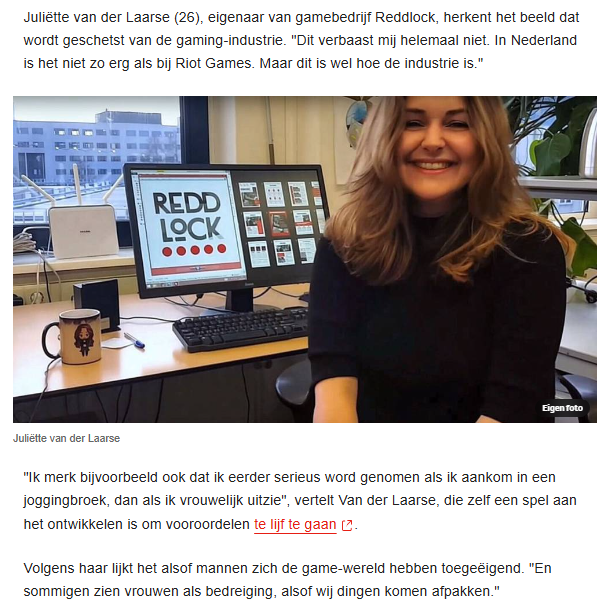
Juliëtte van der Laarse (26), eigenaar van gamebedrijf Reddlock, herkent het beeld dat wordt geschetst van de gaming-industrie. “Dit verbaast mij helemaal niet. In Nederland is het niet zo erg als bij Riot Games. Maar dit is wel hoe de industrie is.”
“Ik merk bijvoorbeeld ook dat ik eerder serieus word genomen als ik aankom in een joggingbroek, dan als ik vrouwelijk uitzie”, vertelt Van der Laarse, die zelf een spel aan het ontwikkelen is om vooroordelen te lijf te gaan.
Volgens haar lijkt het alsof mannen zich de game-wereld hebben toegeëigend. “En sommigen zien vrouwen als bedreiging, alsof wij dingen komen afpakken.”
In het artikel over Riot Games gaat het over het gebrek aan kansen voor vrouwen bij het bedrijf. Zo zouden vrouwen minder kans maken op promotie en zouden sollicitanten zijn afgewezen omdat ze geen “echte gamers” waren. Het bedrijf zou de LoL-statistieken van sollicitanten van tevoren opvragen.
Überhaupt maken vrouwen al minder kans bij Riot Games, omdat zo’n 90 procent van LoL-spelers man is. Dat zo weinig vrouwen de game spelen is wellicht niet zonder reden, want in het spel hebben ze het vaak zwaar. Van der Laarse beaamt dat het seksisme in de industrie hetzelfde is als in de game-community’s zelf. “Vooral League of Legends staat erom bekend. Ik ken ook heel veel mensen die het om die reden niet meer spelen.”
Zelf is ze ook gestopt met LoL. “Ja, want die community is best wel toxic. Als ze erachter kwamen dat ik een meisje was, dan kwam er vaak gedoe. In het beste geval vroegen ze alleen naar mijn naam, dan kwam soms het spel stil te liggen omdat ze alleen nog wilden chatten.”
50/50
Maar ze heeft ook vervelendere incidenten meegemaakt. “Dat ze dingen zeggen als: ik wil jou niet mijn team omdat je een meisje bent. Of dat ze je buiten de game gaan zoeken en dan benaderen op Facebook ofzo. Daar zit ik natuurlijk niet op te wachten.”
Wat de oplossing voor het probleem in de gaming-wereld is, weet ze niet, maar Van der Laarse probeert wel haar eigen steentje bij te dragen. Ze pleit namelijk voor het aannemen van meer vrouwen. “Dat doe ik in mijn eigen bedrijf ook. Op dit moment is het 50/50 en voor als ik straks ga uitbreiden heb ik al wat talentvolle vrouwen op mijn lijstje staan.”
Translated Article (English)
Sexism at the maker of League of Legends: “This is what the game industry is like”
Photos of genitals, lists of “eligible women,” and promotions that consistently pass women by — a sexist culture prevails at the large American game developer Riot Games, according to the gaming website Kotaku.
Riot Games is best known for the online game League of Legends (LoL), which is played monthly by tens of millions of people. A journalist interviewed 28 (former) employees. Most said that women have a hard time at the company, which employs around 2,500 people.
One woman described how one of her ideas was rejected during a meeting. As an experiment, a male colleague pitched the same idea a few days later to the same group of people. “And everyone said, ‘Oh my god, this is fantastic.’ They just don’t respect women.”
Another employee said she once came across an email conversation in which male colleagues described “what it would be like to penetrate her.” One of them added that it would be a good idea to sleep with her and then never speak to her again.
“The bro culture there is so strong,” said one of the interviewees, who quit her job due to sexism. “It feels like working at a huge fraternity.” The term bro culture refers to a male-dominated environment where men refer to one another as “bro.”
Riot Games is certainly not the first game company to come under fire for sexism. Quantic Dream, the French developer behind Detroit: Become Human, recently lost a defamation lawsuit. The company had sued three journalists who had written about sexism and racism in the workplace.
“This doesn’t surprise me at all,” says Juliëtte van der Laarse (26), owner of the Dutch game studio Reddlock. “In the Netherlands, it’s not as bad as what’s described at Riot Games. But this is what the industry is like.”
“I’ve noticed that I’m taken more seriously when I show up in a hoodie and sweatpants than when I look feminine,” says Van der Laarse, who is currently developing a game designed to challenge stereotypes.
According to her, it sometimes feels as though men have claimed ownership of the gaming world. “And some of them see women as a threat, as if we’re here to take something away from them.”
The Kotaku article about Riot Games also describes how women have fewer career opportunities at the company. Female employees were reportedly passed over for promotions, and job applicants were rejected for not being “real gamers.” The company allegedly reviewed applicants’ League of Legends statistics in advance.
Women already have a harder time at Riot Games simply because around 90 percent of LoL players are men. That imbalance may not be coincidental, since women often face hostility in the game itself. Van der Laarse confirms that sexism in the industry mirrors what happens in gaming communities. “League of Legends in particular has that reputation. I know a lot of people who stopped playing because of it.”
She herself has also quit playing LoL. “Yes, that community is quite toxic. If people found out I was a girl, there was usually some kind of drama. In the best case, they’d just start asking my name — and sometimes the whole game would come to a standstill because everyone wanted to chat instead of play.”
50/50
She’s also experienced worse incidents. “People saying things like, ‘I don’t want you on my team because you’re a girl.’ Or tracking you down outside the game to contact you on Facebook or elsewhere. That’s not something I’m looking for, obviously.”
Van der Laarse isn’t sure what the ultimate solution is, but she’s trying to make a difference in her own way — by hiring more women. “That’s what I do in my own company too. Right now, our team is 50/50, and when we expand, I already have a few talented women on my list.”