In June 2018, I was approached by Ellis Portier, a journalist from HvAna, the news platform of the Amsterdam University of Applied Sciences (HvA). She was interested in a new project I was working on at the time: ScienceTales.
We met at PLNT Leiden, which was then still called Hubspot, a collaborative workspace for startups and early-stage entrepreneurs. It was where our small team gathered each week to brainstorm, code, and build. We had a little corner there that we half-jokingly called our “studio.” In reality, it was a modest open space filled with whiteboards, coffee mugs, and the kind of creative chaos that only small teams can pull off.
Ellis came by, and the conversation flowed easily. We talked about the transition from ReddLock Studios, my previous company, which had been B2B (business to business), to our new venture, ScienceTales, which was B2C (bringing educational games directly to children and parents). It was a huge change and a big risk. ReddLock had been stable and profitable, but I wanted to build something that reflected my ideals: to help children see that science isn’t dry or abstract, but alive, beautiful, and deeply human.
To make that dream possible, we scaled down to a smaller, more agile team connected not just by work but by shared curiosity. Many of us were affiliated with Leiden University in some way: employees, master’s students, bachelor’s students, and even a PhD researcher who used ScienceTales as the subject of their thesis. That connection gave us access to library spaces and resources and created a space where creativity and research could naturally blend.
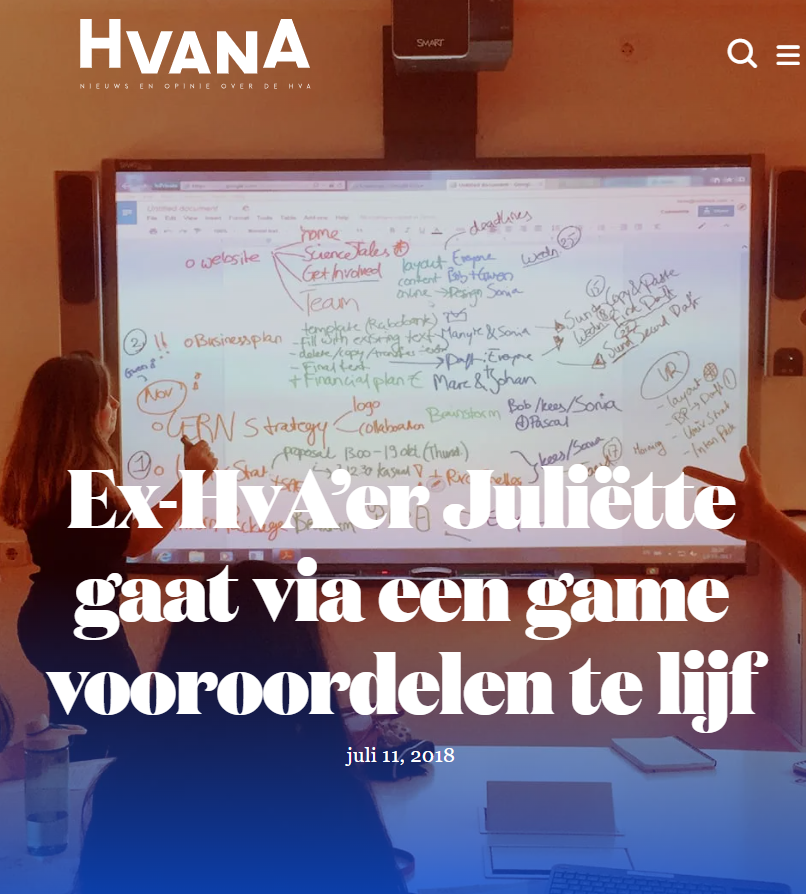
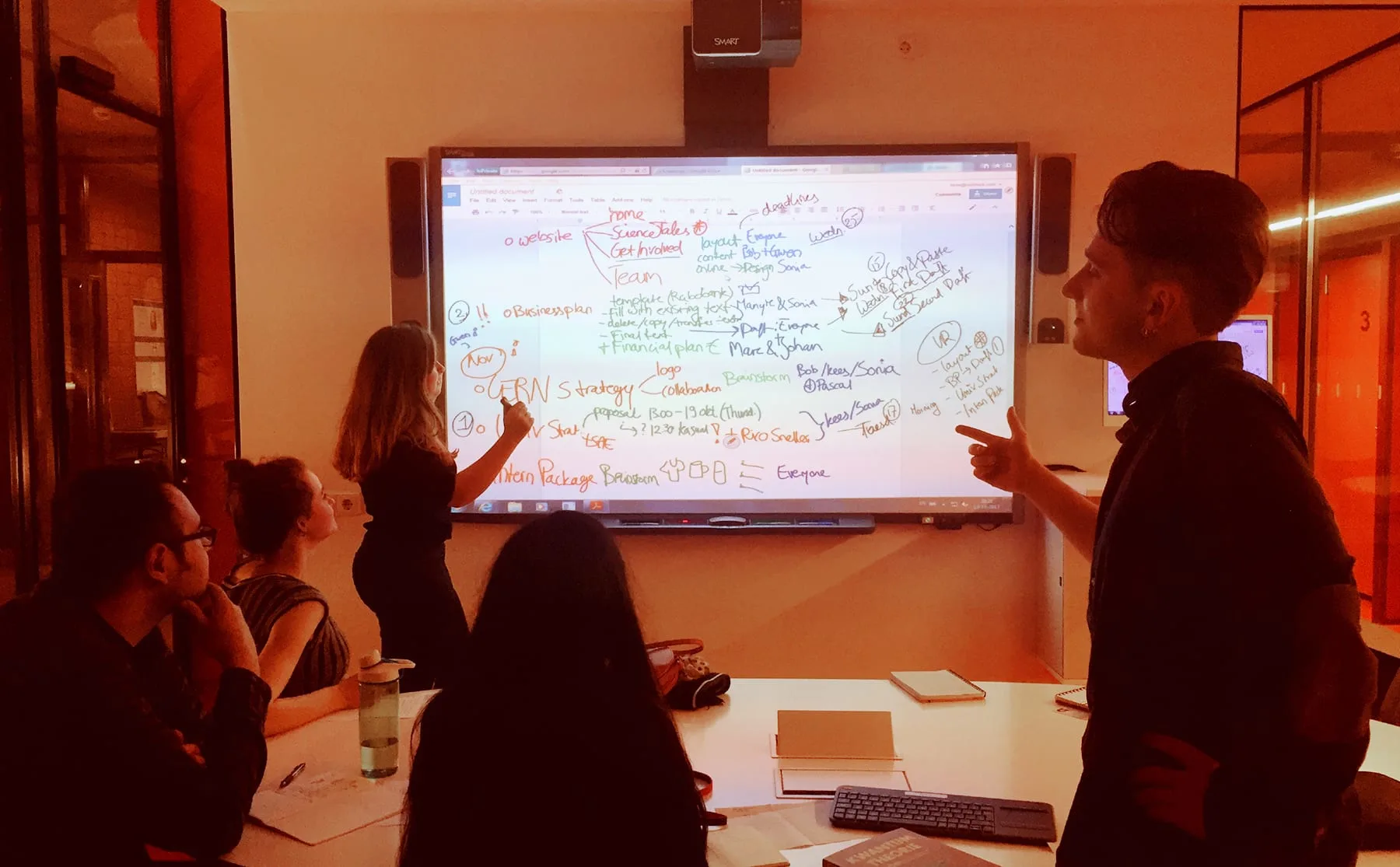
What I personally still like most about this article is the cover photo. The cover photo for the article was taken in one of those small study rooms in the Leiden University Library. It was a quiet, cozy room that students and staff could reserve, warm, with soft lighting and just enough space for a digital whiteboard, a few laptops, and too many coffee cups. In the photo, we’re mid-brainstorm, sketching storylines and strategies. Every time I see it, I’m reminded of that early phase, the hopeful energy of a small, idealistic team dreaming something into being.
Archive Info
Original Language: Dutch Title: Ex-HvA’er Juliëtte gaat via een game vooroordelen te lijf
Publication Date: 11 Juli 2018
Publisher: HvAna
Direct Link: Interview on HvAna
About This Archive
Welcome to my Media Archive. In this curated collection, I explore the media appearances and interviews that have marked my journey through technology and beyond. This archive is not just a record of professional milestones; it is a personal journey through moments that have defined and shaped my public persona.
Ellis gave me the space to share the heart behind ScienceTales and how we wanted to use storytelling, metaphor, and interactivity to help children understand physics and mathematics in a way that felt natural and intuitive. We also talked about diversity in the gaming world and how our character Cam would be non-binary, something rarely seen in educational media at the time. I remember her genuine curiosity, her openness, and how safe it felt to talk about these things so honestly.
That article captured us exactly as we were: young, idealistic, full of ideas, without guarantees but with so much hope. We didn’t know where it would all lead yet, but we knew we were building something that mattered.
When I look at that photo now, I can still feel it, that spark from the very beginning when everything was new, pure, and full of possibility. It was a beautiful time, and I carry it with me still.
Article & Translation
Translated Article (English)
Former HvA Student Juliette Tackles Bias Through Gaming
July 11, 2018
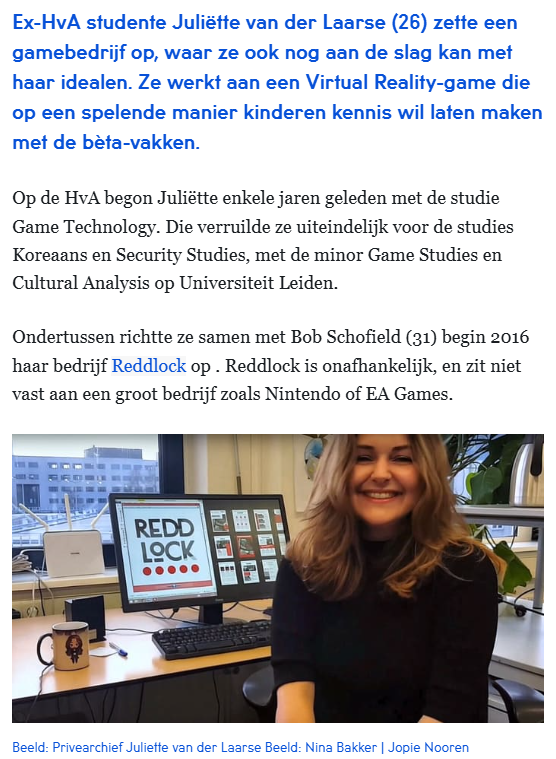
Former Amsterdam University of Applied Sciences (HvA) student Juliette van der Laarse (26) founded a game company where she can also put her ideals into practice. She is working on a Virtual Reality game that aims to introduce children to science subjects in a playful way.
Juliette started her studies in Game Technology at the HvA a few years ago. She later switched to Korean Studies and Security Studies, with a minor in Game Studies and Cultural Analysis at Leiden University.
In early 2016, she founded her company ReddLock together with Bob Schofield (31). ReddLock is independent and not tied to a large company such as Nintendo or EA Games.
Juliette recalls that, when she first started, people sometimes reacted strangely to a young woman in the gaming world. “There was a weekend event when I had just started at HvA. We formed a team of three women, which had never happened before. Everyone wanted to interview us — newspapers, game blogs, magazines, and websites. One reporter even asked: ‘You’re spending a weekend here with a building full of men. Do you hop from sleeping bag to sleeping bag at night?’ We made sure he was escorted out rather quickly.”
Diversity has always been important to Juliette. “When I was growing up, I only saw older white men working in tech.” Fortunately, she says that people who make sexist remarks like that are now a small minority.
At first, other companies hired ReddLock for projects. Although this earned her a decent income, Juliette was unsatisfied. “I felt like I was spending all my time promoting the company and chasing new clients.” It didn’t align with her ideals. That’s when the idea emerged to create her own game — one that could reflect her values around diversity.
Friday Afternoon Drinks
The idea for the game ScienceTales started during a casual Friday afternoon get-together, as a fun side project. Eventually, Juliette told her team: “I really want to go for this. A lot is going to change, and we’ll have no financial security anymore. But if it works, this will be such a meaningful project to work on.” Her team agreed without hesitation.
The game they are now developing is called ScienceTales. It’s an interactive Virtual Reality game for children aged ten to twelve that helps them learn the basics of physics and mathematics.
“We do this through storytelling and the use of metaphors. The idea is that children, through interaction with the game, will intuitively pick up concepts they might not otherwise learn.” She hopes to show children that science subjects are not just dry or abstract.
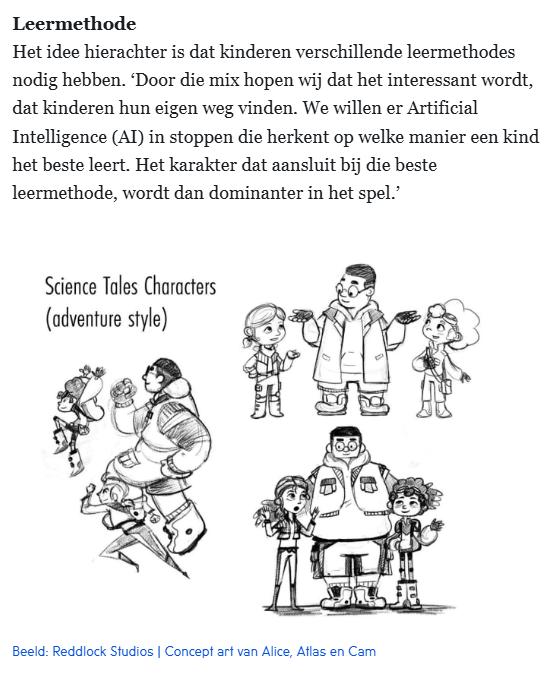
To achieve this, the game features three main characters. Each uses a different learning method. Atlas tells interactive stories, Cam uses mini-games, and Alice focuses mainly on facts.
Learning Methods
The idea behind this is that children need different approaches to learning. “By offering this mix, we hope to keep it engaging and allow children to find their own way. We want to include Artificial Intelligence (AI) that can recognize how a child learns best. The character that fits that learning style will then become more prominent in the game.”
Juliette also wants the game to be as diverse as possible. For example, Cam is a non-binary character — meaning they do not identify as either male or female.
That ideal does come with challenges. “How do you address a non-binary person? In English you can use ‘they’ or ‘them,’ but in Dutch we don’t really have an equivalent yet,” she explains.
Some primary schools even warned her: “Non-binary language is not allowed in classrooms because it’s not yet recognized as official Dutch.”
Consumers
Juliette therefore decided to adapt the original idea and release ScienceTales for consumers first. Instead of being a classroom tool, it is now being developed as a game for personal use.
That has one major advantage. Because they are no longer bound by the strict regulations of primary schools, they can create more freely and shape it according to their own vision. “The form has changed a bit, but the original idea hasn’t. We’ve now been able to infuse much more of our own ideals into it.”
Original Article (Dutch)
Ex-HvA’er Juliëtte gaat via een game vooroordelen te lijf
juli 11, 2018, by Ellis Portier
Ex-HvA studente Juliëtte van der Laarse (26) zette een gamebedrijf op, waar ze ook nog aan de slag kan met haar idealen. Ze werkt aan een Virtual Reality-game die op een spelende manier kinderen kennis wil laten maken met de bèta-vakken.
Op de HvA begon Juliëtte enkele jaren geleden met de studie Game Technology. Die verruilde ze uiteindelijk voor de studies Koreaans en Security Studies, met de minor Game Studies en Cultural Analysis op Universiteit Leiden.
Ondertussen richtte ze samen met Bob Schofield (31) begin 2016 haar bedrijf Reddlock op . Reddlock is onafhankelijk, en zit niet vast aan een groot bedrijf zoals Nintendo of EA Games.
Juliëtte merkte toen ze net begon, dat mensen af en toe vreemd reageerden op een jonge vrouw in de gamewereld: ‘Er was een weekendevenement toen ik net op de HvA was begonnen. We vormden met drie vrouwen een team; dat was nog niet voorgekomen. Iedereen wilde ons daarover interviewen – kranten, gameblogs, tijdschriften en websites. Een verslaggever vroeg: “Je zit nu een weekend lang met allemaal mannen in een groot gebouw, hop je ’s avonds niet even van slaapzak naar slaapzak?” Die hebben we er heel snel uitgebonjourd.’
En dat terwijl diversiteit voor Juliëtte belangrijk is. ‘Toen ik opgroeide, zag ik inderdaad alleen maar blanke oude mannen in de techniek.’ Gelukkig zijn mensen die seksistische opmerkingen maken volgens haar in de minderheid.
Eerst huurden andere bedrijven Reddlock in voor projecten. Hoewel ze daar aardig wat geld mee verdiende, was Juliëtte ontevreden. ‘Ik had het gevoel alleen nog maar bezig te zijn met het promoten van mijn bedrijf, en het zoeken van nieuwe opdrachten.’ Dit paste niet bij haar idealen. Zo ontstond het idee om een eigen game te gaan maken, waarin ze ook haar idealen rond diversiteit kwijt kon.
Vrijdagmiddagborrel
Het idee van het spel ScienceTales ontstond tijdens een vrijdagmiddagborrel, als een leuk project voor erbij. Uiteindelijk zei Juliëtte tegen haar team: ‘Ik wil hier echt voor gaan. Er gaat heel veel veranderen, en we hebben geen financiële zekerheid meer. Maar als het lukt, is dit echt een heel mooi project om aan te werken. Mijn team was het er helemaal mee eens.’
De game die zij nu aan het ontwikkelen zijn, heet ScienceTales. Het moet een interactieve virtual reality game worden voor kinderen tussen de tien en twaalf waarmee ze de basis van natuurkunde en wiskunde leren.
‘Dit doen wij door middel van het vertellen van verhalen, en het gebruik van metaforen. Het idee is dat de kinderen door de interactie met het spel concepten oppikken die ze normaal misschien niet zouden leren.’ Ze hoopt zo aan kinderen te kunnen laten zien dat de bèta-vakken niet alleen droge stof zijn.
Om dit te bereiken, krijgt het spel drie karakters. Deze karakters gebruiken verschillende leermethodes. Atlas gaat interactieve verhalen gebruiken, Cam mini-games, en Alice zal voornamelijk gebruik maken van feitjes.
Leermethode
Het idee hierachter is dat kinderen verschillende leermethodes nodig hebben. ‘Door die mix hopen wij dat het interessant wordt, dat kinderen hun eigen weg vinden. We willen er Artificial Intelligence (AI) in stoppen die herkent op welke manier een kind het beste leert. Het karakter dat aansluit bij die beste leermethode, wordt dan dominanter in het spel.’
Juliëtte wil de game ‘zo divers mogelijk maken.’ Cam is bijvoorbeeld een zogeheten non-binair karakter. Non-binair houdt in dat je je geen man en geen vrouw voelt.
Dat ideaal stuit op problemen. Want hoe spreek je een non-binair persoon aan? ‘In het Engels heb je daar natuurlijk they of them voor, maar in het Nederlands bestaat er nog niet echt zoiets,’ vertelt ze.
Een paar basisscholen waarschuwden haar ook: ‘Non-binaire taal mag op basisscholen niet worden gebruikt, omdat dit nog geen erkend Nederlands is.’
Consumenten
Juliëtte besloot daarom het originele idee aan te passen, en ScienceTales eerst alleen voor consumenten uit te brengen. In plaats van een klassikale vorm, werken ze nu aan een spel voor persoonlijk gebruik.
Dat heeft één voordeel. Omdat ze nu niet meer ‘vastzitten’ aan de strenge eisen van basisscholen kunnen ze vrijer zijn en het meer naar hun eigen idee vormgeven. ‘De vorm is een beetje veranderd, maar het oorspronkelijke idee niet. We hebben nu veel meer onze eigen idealen erin gestopt.’