The People Greenhouse
Everything you need to thrive at work
Things thrive when the conditions around them are right. And I believe shaping those conditions is the responsibility of leadership. I have always genuinely cared about those I lead, and for the part of their career journey I get to share, I want them to thrive, whatever thriving means to them as a person.
The People Greenhouse grew out of that conviction, and turns it into a framework for professional growth. It maps everything to look at when working on someone’s growth, including your own: what to check in on, and where the support for it comes from. You can use it on your own, or together with your manager and others who help you grow.
In this greenhouse, you are the cultivator, and your professional self is the variety you choose to grow.
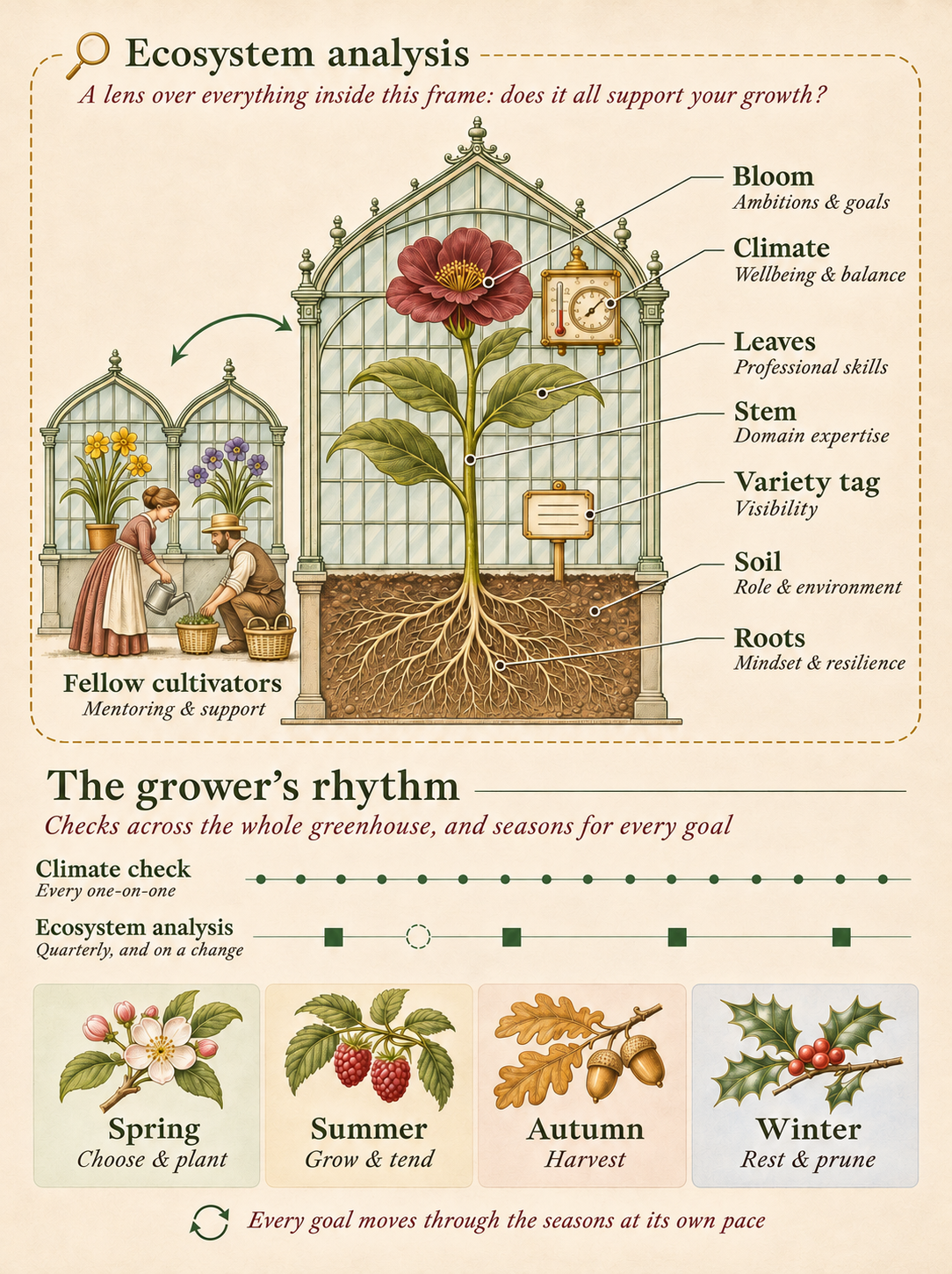
Plate I — The People Greenhouse, in vintage school wall chart style.
contents

Fig. 1 — The cultivator at work, one rose at a time.
prologue
How to use this greenhouse
The People Greenhouse is meant to be used, not just read. Four steps to get started:
- Get to know the greenhouse. Read through the chapters below, so you know what each part stands for.
- Choose where to map it. A digital whiteboard such as Miro, a OneNote notebook, a wall with sticky notes: anything works, as long as each part gets its own space and you can keep adding to it.
- Map your greenhouse, part by part. Each part links to a page with more guidance to fill it in and track how you are doing. Do it on your own, or with your manager, a coach or anyone else who helps you grow.
- Look at what is already there. Your organisation may already support some parts, through HR systems, a training budget, a mentoring programme or wellbeing support. You don’t have to grow everything from scratch.
the cultivators
in your greenhouse
You, the cultivator
Growing your own variety
It’s your greenhouse. You decide what to grow, and you do the tending. Nobody can grow your roots for you, but you also don’t have to do it alone.
alongside you
Fellow cultivators
Helping you grow it
Mentors, coaches, peers, and ideally your manager. Some walk through the whole greenhouse with you, others help with a single part.
And in someone else’s greenhouse, you can be a fellow cultivator.
chapter i
Your variety
Every thriving flower rests on more than its bloom: strong roots, a sturdy stem and healthy leaves. A tag beside it helps too, so others know what is growing, can appreciate it, and take it into account. A cultivator first decides which variety they want to see bloom, and then makes sure the whole plant is truly thriving. Your professional growth works the same way.
Bloom
ambitions & goals
What do you wish to let bloom, and what drives you there?
Stem
domain expertise
What knowledge carries you, and lets you grow taller?
Leaves
professional skills
How do you show up when working with others?
Roots
mindset & resilience
What keeps you standing through drought and storms?
Variety tag
visibility
Can others see, and appreciate, what is growing here?
chapter ii
The growing conditions
No variety grows in isolation. Around it are two kinds of conditions: the soil it is planted in, and the climate inside the greenhouse.
The soil is your professional environment. It changes slowly: you rarely choose it completely, but you can often improve it. The climate is how you experience that environment, day by day. It changes fastest of all, so you check it most often.
Here, you simply take stock of how both are. Whether they truly nurture your growth is a question for the ecosystem analysis.
the soil · role & environment
What is your soil like?
Your role, team and company. Is it psychologically safe, does your role leave room for the challenges you want to take on, and how manageable and flexible is your workload?
the climate · wellbeing & balance
How is your climate?
How you experience it all, measured on sliders. Some are general, like your energy and balance. Others are personal, like the kind of work or freedom you want more of.
chapter iii
Analysing the ecosystem
Now you step back and look at the whole. First, the state of your ecosystem: every part of your variety, the soil, the climate and your fellow cultivators. Is everything being tended, and how?
Then you zoom in on the two things that can help your whole greenhouse thrive: your soil and your fellow cultivators. What is their impact on your ecosystem, positive or negative? And can improvements be made?
I
the first lens · health
How is each part doing?
Every part of your plant, your climate and your soil. How is each of them doing?
II
the second lens · the soil
Is your soil helping?
Does your role and environment support each part of your plant, and your climate?
III
the third lens · fellow cultivators
Are you supported?
For each part you are developing: is there a mentor, teacher or coach to help?
chapter iv
The grower’s rhythm
Two kinds of rhythm run through the greenhouse. The checks that keep everything healthy, at a steady pace. And the seasons each goal moves through, at its own pace.
Climate check
regular checks
Ecosystem analysis
every quarter, and on a change
And every goal moves through its own seasons
Spring
choose & plant
Summer
grow & tend
Autumn
harvest
Winter
rest & prune
Many of the people I have managed will recognise this greenhouse, even though it didn’t have a name before.
Each of them had their own private board, which we filled in together and returned to at every check-in. Instead of the generic reporting our HR systems asked for, it gave us regular, personal conversations about what they wanted, what they needed, and what we could change. And it was truly theirs.
a note on use
Use it, adapt it, credit it
I am sharing The People Greenhouse openly. It has helped me and the people I have worked with a great deal, and I hope it can help you too: whether you use it for yourself, together with your manager, or as a manager or coach with the people you support. Adapt it to what works for you.
All I ask is that you credit me as its creator, so others can find the original. The People Greenhouse is licensed under CC BY-SA 4.0. Use without credit falls outside this licence, and in that case I reserve the right to charge a fee.
also
Beyond the page
The People Greenhouse is made to be used without me: everything you need is in this guide. Still, if you’d like to explore it together with your team or audience, I love doing that in person.
My agenda is quite full, but when it allows, I’m open to discussing a professional engagement: a work session with a team or smaller group, or a talk for a larger group.