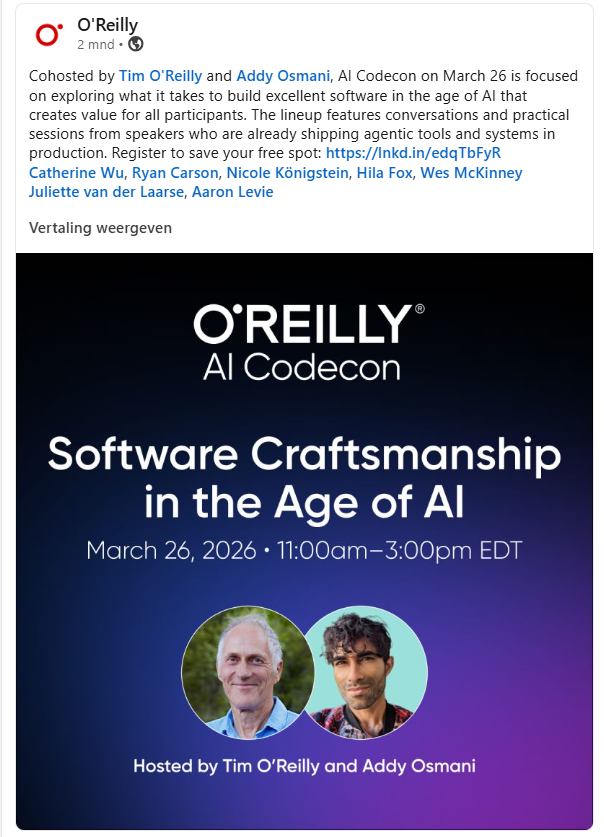
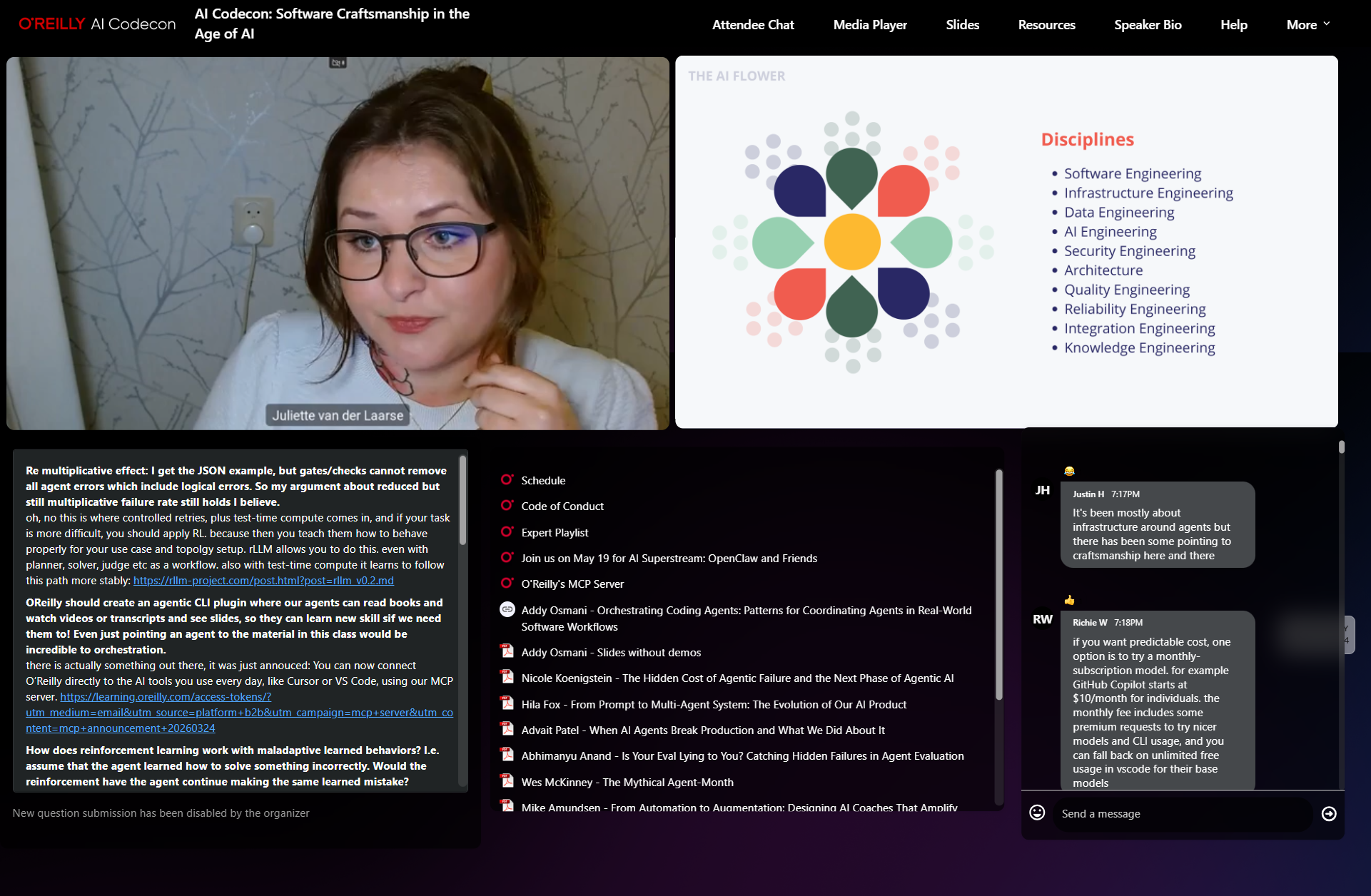
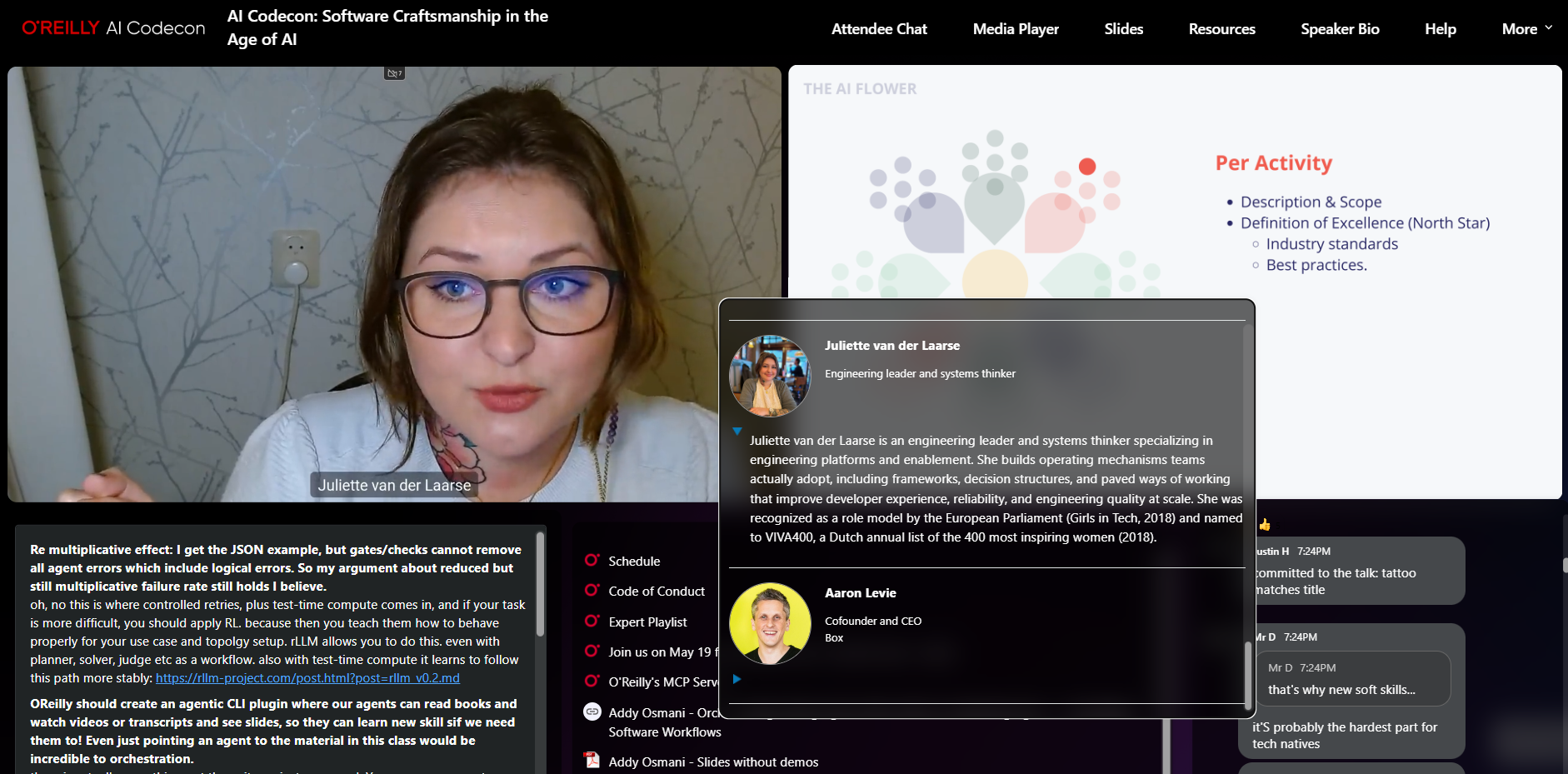
On 26 March 2026, I had the honour of presenting as one of the main speakers at O’Reilly AI Codecon: Software Craftsmanship in the Age of AI. The event was a free, virtual conference hosted by O’Reilly, with around 5,000 online attendees from across the world.
The conference focused on the new skills developers need in the age of agentic AI, including context engineering, evaluation, collaboration, multi-agent workflows, and the changing nature of software craftsmanship. It was co-hosted by Tim O’Reilly, founder of O’Reilly Media, and Addy Osmani, Director of AI at Google Cloud.
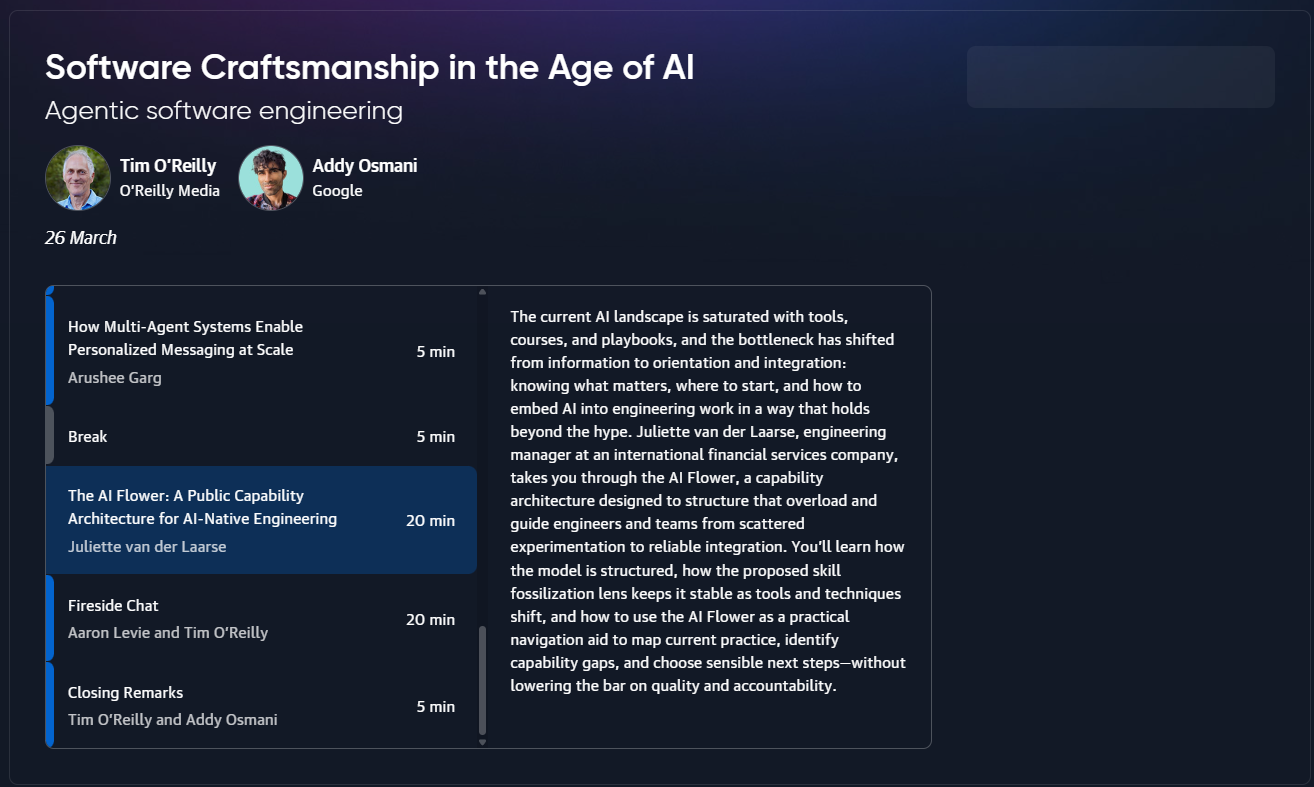
My talk was titled The AI Flower: A Public Capability Architecture for AI-Native Engineering. The AI Flower is a capability architecture I have been developing to help engineers, teams, and organisations understand what AI is changing in engineering work, where capability gaps are emerging, and how to move from scattered experimentation to more reliable integration.
Archive Info
Title: The AI Flower: A Public Capability Architecture for AI-Native Engineering
Date: 26 March 2026
Organizer: O’Reilly Media
Direct Link: Rewatch Online (for free)
About This Archive
Welcome to my Media Archive. In this curated collection, I explore the media appearances and interviews that have marked my journey through technology and beyond. This archive is not just a record of professional milestones; it is a personal journey through moments that have defined and shaped my public persona.
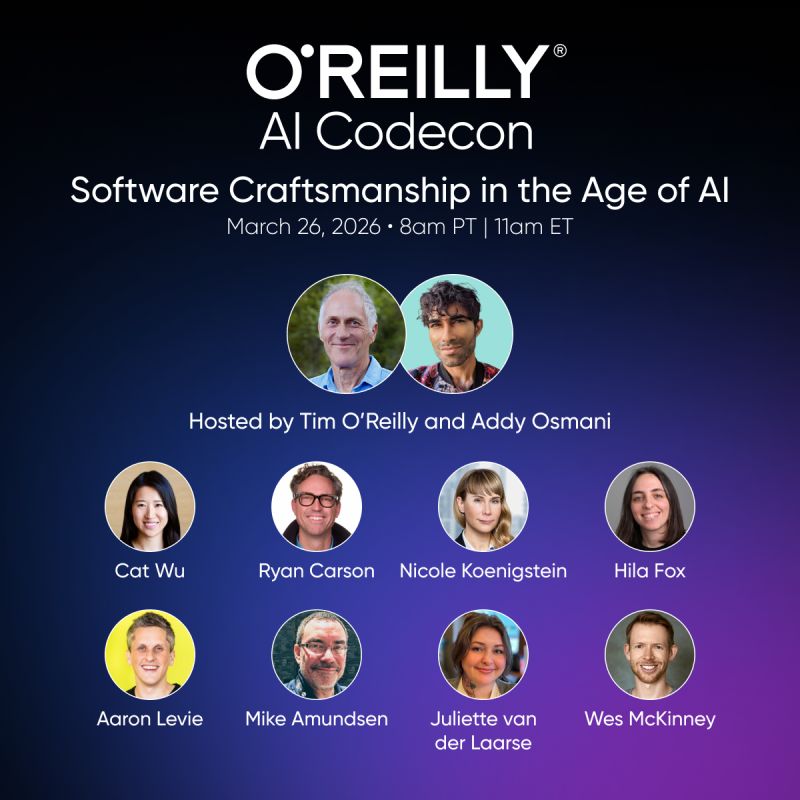
The opportunity came after I had previously published an article about the AI Flower on O’Reilly Radar. That publication already meant a lot to me, so being invited to present the model during AI Codecon felt like an important next step. Especially because the conference brought together people who are actively thinking about the future of software development, not from a place of hype, but from a place of craft, quality, accountability, and real engineering practice.
In my session, I shared why I created the AI Flower, how the model is structured, and how it can be used as a practical navigation aid for AI-native engineering. I also introduced the skill fossilization lens, which helps reason about which engineering skills remain durable, which ones evolve, and which ones may eventually become abstracted into tools, workflows, or infrastructure.
What made this moment especially meaningful to me was the timing. Only four weeks before the conference, we had my father’s funeral. In all honesty, there was a point where I was not sure I would be able to do this presentation. My energy was gone, my motivation was low, and I did not know whether I could pull myself together enough to show up in the way I wanted to.
But I also felt that this project had started to become something larger than just an idea I was quietly working on in my spare time. I had been building momentum, and I did not want to lose that. So I pushed through, prepared as well as I could, and gave the presentation with everything I had.
Looking back, I am genuinely glad I did. The response afterwards was incredibly encouraging. Many people reached out to say they were looking forward to seeing the AI Flower published and made available. That meant a lot to me, especially because this is something I have been developing outside of work, in my own time, with the intention of sharing it publicly and freely.
For me, this event confirmed that the AI Flower is not only a personal passion project. It speaks to a real need in the industry: the need for structure, orientation, and language around what AI is changing in engineering work. I look back on AI Codecon with gratitude, not only for the opportunity to speak on such a platform, but also for the reminder that sometimes the work that takes the most energy is also the work that opens the next door.
You can watch a recording of the online conference here