At the end of September 2020, I was interviewed once more by Mare Magazine, this time for an article about students who were building startups alongside their studies. I was studying at Leiden University’s The Hague campus at the time, and working on ScienceTales, an educational game designed to make physics come alive, to show that it isn’t just formulas and numbers, but the world itself, full of movement and cause and effect.
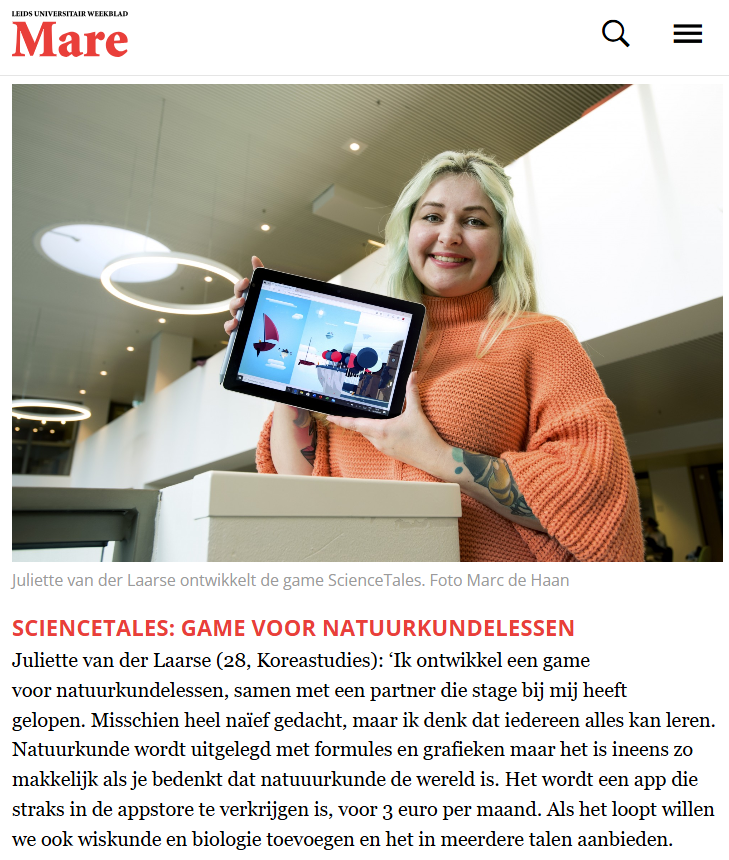
It was a short, simple moment in a very busy period. We took the photo in one of the university corridors, quickly, in between classes and deadlines. There wasn’t much time for preparation, but that felt fitting somehow. When you are building something from the ground up, you learn to grab small windows of opportunity whenever they open. This was one of them.
The conversation was light and genuine. We talked about learning, about building something meaningful, and about how creativity and technology meet when you let curiosity lead the way. It wasn’t a big production, no studio lights or rehearsed answers, just an honest conversation in the middle of everything else.
When I look back at the photo now, what makes me smile most isn’t the interview itself, but my absolutely horrible-looking hair. I was nearing thirty and realised I had never done anything playful or wild with it. So I decided I wanted to try something bold, just once, before that milestone. I chose baby blue, mostly because I couldn’t imagine anything more bold, different, and whimsical. Unfortunately, only weeks after, the pandemic hit. The salons closed, appointments were scarce when they finally reopened, and that carefully planned experiment turned into quite a saga. For those unfamiliar with bold colors, redoing it is a monthly affair, and to keep my roots from showing, I would have to come in regularly as well.
The blue faded into a chemical green, then bright yellow, and my natural roots kept growing until eventually salons opened once more, and I dyed it back to a more familiar shade. It’s funny now, but at the time I remember feeling both amused and slightly horrified. It taught me something though: that even in imperfection, there’s room for joy. You can still show up, do your work, tell your story, even when your hair refuses to cooperate.
And one more thing I learned (from my previous Mare interview) is to never (ever!) read the social media comments. So I have no idea how this one was received, and perhaps that’s for the best.
Looking back, I think this interview became a quiet reminder of what I value most. That the real stories often happen in between everything else, in hallways, in small windows of time, in moments that weren’t planned to be special, but end up being meaningful anyway.
Archive Info
Original Language: Dutch Title: Deze studenten begonnen voor zichzelf
Publication Date: 02 November 2020
Publisher: Leids Universitair Weekblad Mare
Direct Link: Interview on Mare
About This Archive
Welcome to my Media Archive. In this curated collection, I explore the media appearances and interviews that have marked my journey through technology and beyond. This archive is not just a record of professional milestones; it is a personal journey through moments that have defined and shaped my public persona.
Article & Translation
Translated Article (English)
Student Life
These Students Started Their Own Businesses
Starting a company takes time and money, but above all, it’s an exciting and valuable learning experience. “We had barely opened our private limited company when we already received a fine from the Dutch Tax Office.”
—– [Interviews with other students]
ScienceTales: A Game for Physics Lessons
Juliette van der Laarse (28, Korean Studies): “I’m developing a game for physics education together with a partner who previously interned with me. Maybe it sounds a bit naïve, but I believe anyone can learn anything. Physics is often explained through formulas and graphs, but it suddenly becomes so simple once you realise that physics is the world around us.
The app will soon be available in the App Store for €3 per month. If it takes off, we want to expand to mathematics and biology as well, and offer it in multiple languages.”
“I started programming when I was twelve and earned some money doing small projects for others. In high school, I took Computer Science and turned out to have a natural talent for it. I studied game development and ICT at university of applied sciences, and I’m now studying Korean Studies because the gaming industry there is huge.”
“In 2015, I founded my first startup, focused on creating educational games and training simulations. In the beginning, I was heavily focused on augmented and virtual reality — they were more experiences than games, really — giving people the chance to experience something and learn from it. I had an office in Leiden and later in Hoofddorp, with a core team of six people: four interns and two freelancers. In 2017, I was listed among the most inspiring Dutch women in the Viva400.”
“The app is nearly finished. These past months, I’ve been fully focused on securing funding.”
Juliette van der Laarse (who previously explained in Mare how she earned 230 study credits in a single year) is working together with Bob Schofield.
Original Article (Dutch)
Studentenleven
Deze studenten begonnen voor zichzelf
Een startup beginnen: het vergt wat investeringen in tijd en geld, maar het is bovenal spannend en leerzaam. ‘We hadden nog maar net onze BV geopend toen we al een boete kregen van de Belastingdienst.’
—– [Interview met andere startup owners]
ScienceTales: game voor natuurkundelessen
Juliette van der Laarse (28, Koreastudies): ‘Ik ontwikkel een game voor natuurkundelessen, samen met een partner die stage bij mij heeft gelopen. Misschien heel naïef gedacht, maar ik denk dat iedereen alles kan leren. Natuurkunde wordt uitgelegd met formules en grafieken maar het is ineens zo makkelijk als je bedenkt dat natuuurkunde de wereld is. Het wordt een app die straks in de appstore te verkrijgen is, voor 3 euro per maand. Als het loopt willen we ook wiskunde en biologie toevoegen en het in meerdere talen aanbieden.
‘Ik programmeerde al op mijn twaalfde en ik verdiende bij door dat ook voor anderen te doen. Op de middelbare school volgde ik het vak Computer Science. Ik bleek er aanleg voor te hebben. Ik heb hbo game development en ICT gedaan en studeer nu Koreastudies omdat de gamebranche daar heel groot is.
‘In 2015 ben ik begonnen met mijn eerste startup: trainingen en games voor educatieve doeleinden. In het begin focuste ik nog heel erg op augmented en virtual reality, toen waren het meer ervaringen dan games: mensen konden ervaren hoe iets was en daar lering uit trekken. Ik had een kantoor in Leiden en later in Hoofddorp, en een vast team van zes waarvan vier stagiairs, plus freelancers. Ik stond in 2017 op de lijst van meest inspirerende Nederlandse vrouwen, de Viva 400.
‘De app is bijna af. De laatste maanden ben ik alleen nog maar bezig met financiering zoeken.
Juliette van der Laarse (die eerder in Mare uitlegde hoe ze 230 studiepunten in één jaar haalde) werkt samen met Bob Schofield.